
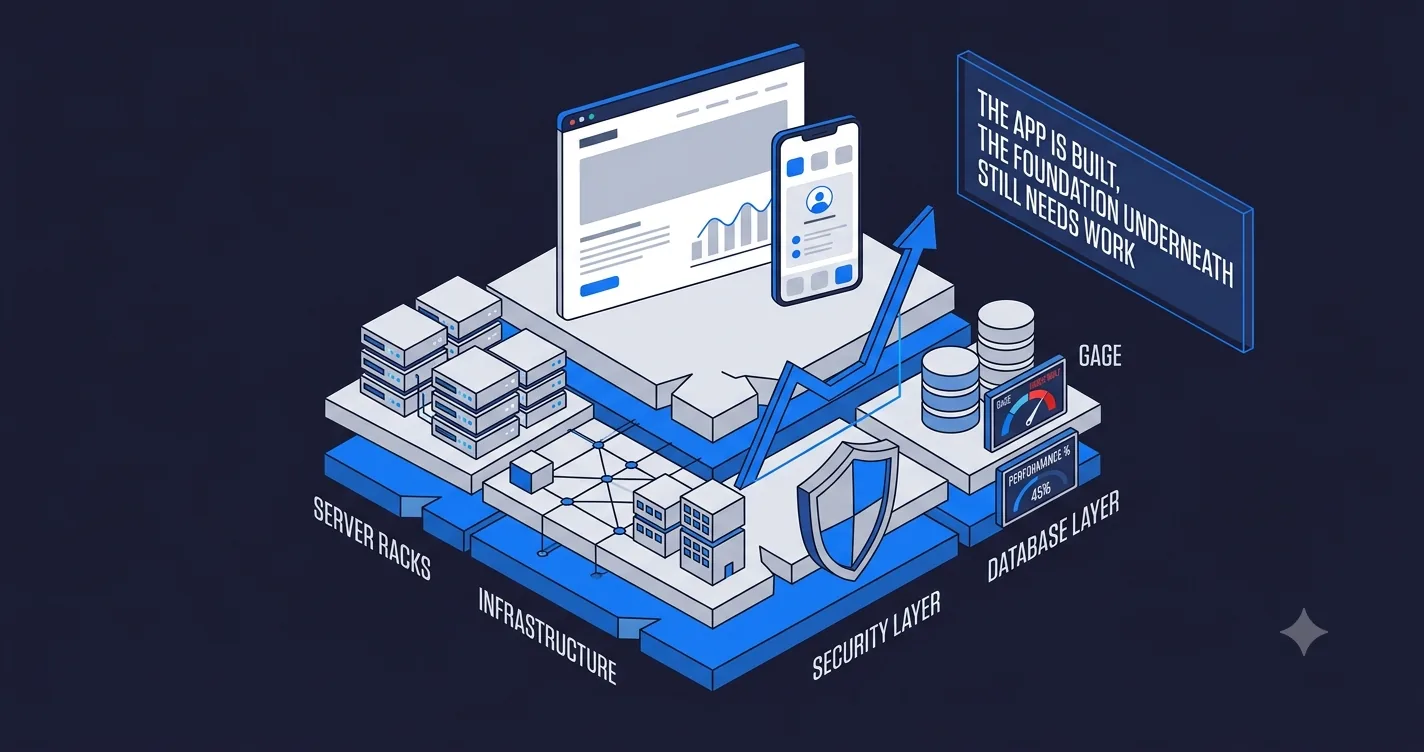
If you built your app with an AI coding tool, Cursor, Claude Code, Bolt, Lovable, or similar, you already know something most engineers do not: exactly how the product should feel. You watched every screen come together, made the calls on the flow, and know instinctively when something is off. That instinct is real and it is valuable. It is also not the same skill as knowing whether your database will hold up when a thousand people sign up in the same week, or whether your hosting bill is quietly three times what it needs to be.
Those two skills, product instinct and infrastructure judgment, rarely live in the same person, and they do not need to. This post is about the second one: what a vibe-coded app actually needs architecturally before it meets real users, how that work also tends to shrink your server bill, and what changes as your user base grows from a handful of believers to a few thousand paying customers.
Why does an app that works in testing still need architecture work?
An AI coding tool, when you prompt it to build a feature, makes a decision every time it writes code: which database call to use, whether to cache a result, whether to run something synchronously or in the background, how many rows to fetch at once. Each individual decision is usually reasonable. None of them are made with your actual traffic pattern in mind, because the AI does not know your traffic pattern, it knows the prompt in front of it.
The result is an app that behaves fine with one user (you, testing it) and behaves very differently with real concurrent load. A page that queries the database inefficiently is invisible when you are the only one loading it. It becomes your slowest, most expensive page the day a hundred people load it in the same minute. This is not a flaw in vibe coding as a method, it is just what happens when every decision gets made in isolation, one prompt at a time, without anyone looking at the system as a whole.
What architecture decisions actually matter once real users show up?
Founders often assume "architecture" means a total redesign. In practice, it is a short list of specific decisions that determine whether your app degrades gracefully or falls over:
- Where your slow queries are, and whether they are cached. Most AI-generated code fetches data fresh on every request. A caching layer (Redis is the standard choice) in front of your most-read data, product listings, user profiles, dashboard stats, is usually the single highest-leverage fix, and it is a targeted addition, not a rewrite.
- Whether slow work happens in the request path or in the background. Sending an email, generating a report, processing an upload, none of these should make a user wait on the same request that triggered them. Moving this to a background job queue (BullMQ, Celery, or your platform's equivalent) is what keeps your app feeling fast even as those tasks get slower under load.
- How your database connections are managed. A common failure mode in vibe-coded apps is opening a new database connection per request instead of using a connection pool. This works fine at low traffic and becomes your outage the moment concurrent users exceed what the database can accept.
- Whether your app can run more than one instance. If session state, file uploads, or scheduled jobs are tied to a single running server, you cannot scale horizontally, you can only make that one server bigger, which has a ceiling and gets expensive fast. Making the app stateless (or externalizing state to a shared store) is what unlocks scaling out instead of just scaling up.
None of this requires knowing anything about your product. It requires someone looking at your actual codebase and traffic patterns and fixing the four or five things that will break first, in the order they will actually break.
How do you harden the app without touching what already works?
Hardening and architecture are related but distinct. Architecture is about performance and scale under real traffic. Hardening is about surviving bad actors, bots, scrapers, and abuse, none of which show up when you are the only one testing the app.
The short version: every public form (signup, contact, waitlist, checkout) needs bot protection, rate limiting needs to exist on every endpoint that writes to your database, and every piece of user input needs to be validated on the server, not just in the browser. We cover this in full technical detail in our guide to hardening a vibe-coded app for production. The founder-level takeaway is simpler: this is not optional, and it is not something that reveals itself in a demo. It reveals itself the first week your app is public and a bot finds your signup form, which happens faster than most founders expect.
How much of your server bill is actually waste?
A meaningful share of hosting spend in a vibe-coded app is not because the app needs that much infrastructure, it is because nobody has looked at what the app is actually doing with the infrastructure it has. A few patterns show up repeatedly:
- Oversized instances running underused apps. AI-assisted deployment flows often default to a comfortable, generous server size. Right-sizing based on actual CPU and memory usage, not guesswork, routinely cuts hosting cost without touching performance.
- Always-on servers for work that is actually bursty. If your workload is spiky (batch jobs, occasional heavy reports, low-traffic nights), serverless or auto-scaling infrastructure that scales to near-zero when idle costs meaningfully less than a server running at full size around the clock.
- No caching, so every request hits the database. Beyond the performance benefit, caching directly reduces database load, which is often billed separately and scales with usage. Fewer database hits is a direct line to a smaller bill.
- Uncompressed assets and no CDN. Serving images, video, and static files directly from your app server instead of a CDN wastes bandwidth you are paying for and slows down every user outside your server's region.
- Redundant or unused cloud resources. Vibe-coded projects accumulate test databases, staging environments, and unused services that nobody remembered to turn off. A basic cloud cost audit finds these in an afternoon.
The pattern across all five: none of them require less infrastructure, they require the right infrastructure, sized and configured for what your app actually does. This is exactly the audit our cloud cost engineers run, and it is usually one of the fastest ways to free up budget for the growth work that actually needs it.
What does "scaling for consumers" actually require in terms of technology?
Scaling is not one thing, it is a sequence of changes that becomes necessary at different points in your growth. A useful way to think about it:
| Stage | What typically breaks | What fixes it |
|---|---|---|
| First real users (dozens to low hundreds) | Slow pages, unhardened forms, no monitoring | Caching, rate limiting, basic observability |
| Early traction (hundreds to low thousands) | Database connection limits, single-server bottlenecks | Connection pooling, horizontal scaling, background job queue |
| Real growth (thousands and climbing) | Database becomes the bottleneck itself, read-heavy pages slow everything down | Read replicas, CDN for static and cacheable content, async processing for anything non-instant |
| Consumer scale (tens of thousands plus) | Single points of failure, deployment risk, cost visibility | Multi-region or multi-zone redundancy, feature flags for safer deploys, dedicated cost monitoring |
The mistake we see most often is founders trying to build for the last row on day one, adding infrastructure complexity for a scale they have not reached yet, which slows down shipping and adds cost with no current benefit. The other mistake is doing nothing until the app is actively failing under load. The right approach is matching the infrastructure to the stage you are actually in, and knowing which signals tell you it is time to move to the next one.
When should a founder bring in a senior developer instead of continuing solo?
You do not need to hand off your product to bring in help with this layer. The founders who get the most value from bringing in a senior engineer at this stage are the ones who keep building the product themselves and hand off exactly this: the architecture, hardening, and cost work that sits underneath what they built. A few honest signals that this is the right moment:
- You are getting real signups or usage, or you expect a launch, press mention, or paid campaign that will bring a traffic spike.
- Pages have started feeling slower as you have added features, and you are not sure why.
- You do not know what your cloud bill would look like at ten times your current usage, and that uncertainty is starting to worry you.
- You have never had anyone look specifically for security gaps, bot protection, or abuse vectors on your public forms.
- You are about to raise, or about to pitch a large customer, and technical due diligence is now a real possibility.
None of these mean your app is bad. They mean the product-building phase and the production-hardening phase are different skill sets, and the second one is worth bringing in deliberately rather than learning under pressure during an incident. This kind of handoff, a defined, bounded list rather than an open-ended hire, is exactly the low-risk starting point covered in how to clear your engineering backlog without pulling your core team off the roadmap.
What does this look like when Workforce Next does it?
We work with founders in exactly this spot regularly, someone who built a genuinely good product with AI tools and now needs the infrastructure layer to catch up to the ambition. The engagement usually starts with an audit, not a rewrite: we look at your actual codebase, your actual traffic (or expected traffic), and your actual cloud bill, and come back with a specific, prioritized list, what breaks first, what is wasting money right now, and what needs to exist before you are comfortable sending real traffic at the app.
From there, our vibe-code optimisation engineers handle the hardening and architecture fixes directly in your existing codebase, and our scalability consulting team scopes the bigger infrastructure decisions if you are heading toward real consumer scale. If the roadmap calls for a dedicated hire rather than a project engagement, our DevOps engineers take over autoscaling, CI/CD, and cloud infrastructure on an ongoing basis. If you are still early and want the architecture right from the start of a new build or major feature, IT consulting is the right starting point instead. Either way, you keep building the product. We handle the part that was never really about the product in the first place.
Final word
Building your app with AI tools was not the shortcut, it was the fast path to proving your idea works, and for that job it is a genuinely good tool. The architecture, hardening, and cost work described here is not a sign that vibe coding failed you, it is the normal next phase of any product that starts getting real users, whether it was built by AI, by a team of ten engineers, or by hand over two years. The founders who handle this phase well are not the ones who become infrastructure experts overnight. They are the ones who recognize it is a distinct skill, bring in someone who has done it before, and get back to building the product they actually understand better than anyone else could.