
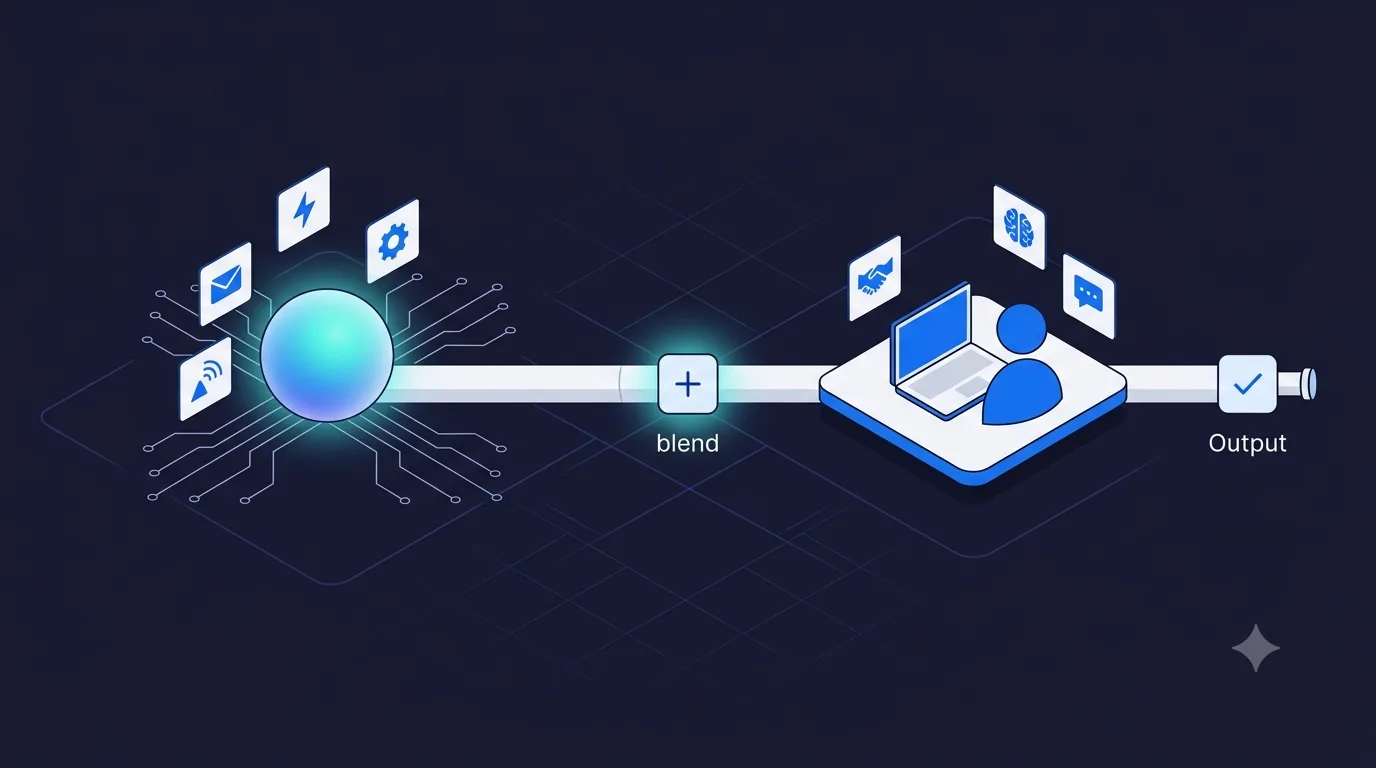
Direct answer: Deploy an AI agent when the work is high-volume, well-defined, and judged on speed-and-coverage rather than nuance. Hire a human when the work is judgment-heavy, relationship-dependent, or touches sensitive trade-offs. Blend both when you need volume and judgment in the same workflow, which is most real businesses. The honest test is not "AI or human?" but "where exactly in this workflow does each one win?"
If you are a founder evaluating done-for-you AI agents against the cost of another hire, this guide is the no-spin version. We deploy both, so we have no incentive to push you toward one. The framing below is the same one we walk customers through on discovery calls.
When an AI agent wins
An AI agent wins when four things are true at the same time:
- The work is high volume. Hundreds of touches per week, not a handful per month.
- The success criteria are objective. "Did the meeting get booked?" beats "did the conversation feel right?"
- Personalization can be inferred from data you already have. Public signals on the lead, ticket history, prior interactions.
- The cost of being wrong on a single case is low. A missed outbound reply is recoverable. A bungled offer negotiation is not.
The clean fits are easy to recognize. Outbound prospecting at the top of the funnel: an AI SDR researches accounts, drafts messages, sends, triages replies. Resume sourcing and first-touch: the agent sweeps LinkedIn and GitHub, sends openers, classifies who responds. Tier-one customer support for known-pattern questions. Ad-hoc data queries against a clean warehouse via text-to-SQL. Standard document processing: invoice extraction, contract clause flagging, repetitive form-filling.
What you give up with the agent is judgment on the long tail. The agent will misclassify a small percentage of replies, misread a candidate's career stage, and occasionally email someone the wrong thing. If those failures are recoverable and you save dozens of hours per week, the trade is good. If a single failure embarrasses you in front of a board member or kills a strategic deal, the trade is bad.
When a human wins
A human wins when one or more of these are true:
- The conversation requires judgment under uncertainty. Negotiating an offer, handling an unhappy enterprise customer, deciding whether a candidate's career gap is a yellow flag or a red one.
- Trust is the deliverable. Founders buy from people they trust. So do recruiters' best candidates. So do enterprise buyers.
- The volume is low and the stakes are high. You do not need an AI agent to handle three offer letters a month; you need a thoughtful recruiter.
- The work is genuinely creative. Designing a positioning narrative, writing a category-defining blog post, drawing an architecture diagram nobody has drawn before.
- The cost of being wrong is uncontained. Pipeline blowups, brand damage, legal exposure.
The clearest fits: AE and senior closer roles in sales. Senior AI engineers on production systems. Analytics work where stakeholder communication matters more than the SQL. Recruiter ownership of the offer-and-close stage. Strategic consulting on what to build. All of these are workflows where a human's judgment is the product, not a layer that wraps the product.
The honest version: a remote expert from a strong talent market still beats most AI agents on judgment-heavy work, and probably will for years. That is not a bug of AI. It is the shape of the technology today.
When to blend (this is most teams)
Most real businesses do not have purely volume work or purely judgment work. They have funnels: AI-agent-friendly motion at the top, human-judgment-heavy motion at the bottom.
A blended setup we ship constantly:
- AI SDR runs top-of-funnel outbound and books meetings. Human AE runs the meetings, qualifies properly, and closes.
- AI recruiting agent sources and first-touches engineering candidates at volume. Human recruiter runs the interviews and owns the offer.
- AI data agent answers ad-hoc "what is happening with X metric?" questions. Human analyst designs the dashboards, runs the strategic deep-dives, and presents to the board.
- AI coding agent scaffolds features and writes boilerplate. Senior AI engineer designs the system, owns production, and signs off on changes that touch customer data.
The pattern is the same in every case. The agent removes the repetitive volume work that was burning your humans. The humans move up the value chain to the work AI cannot do yet. Headcount usually stays flat or grows; output multiplies.
If you are deciding whether to "use an AI agent OR hire a human," you are usually asking the wrong question. The right question is "where does each one belong in this workflow?"
A simple decision checklist
Walk any specific workflow through these six questions before you decide.
- Volume: Are we doing this 50+ times a week, or 5 times a month?
- Definition: Can I write a clear success rubric in 3 sentences?
- Personalization: Can the personalization be inferred from public data?
- Stakes per case: Is a single failure recoverable, or does it cost the business significantly?
- Judgment density: What percentage of decisions need a human read on context the agent cannot see?
- Relationships: Does the person on the other end care that they are talking to a person?
If 1, 2, 3 are "high" and 4, 5, 6 are "low," deploy an AI agent. If 4, 5, 6 are "high" and 1 is "low," hire a human. If 1 is high AND 5 or 6 is high, you are in blend territory.
Cost reality
The cost question gets distorted on both sides. Vendors selling AI agents quote per-message economics and skip the setup cost. Vendors selling humans quote a salary and skip the recruiting time, onboarding lag, and ramp.
A more honest read:
- AI agents have meaningful setup cost. Configuration, integration with your stack, sending infrastructure for outbound, eval harnesses for production AI. The per-touch cost is low after that. Skip the setup work and the agent underperforms a junior intern.
- Humans have meaningful ramp cost. Recruiting a senior takes weeks. Onboarding takes more weeks. Real productivity arrives a quarter or two in. Skip the ramp and you get a senior who never gets context.
- Blended setups have meaningful coordination cost. Someone has to own where the hand-off happens and what the agent escalates. Skip this and the agent and the human duplicate work or miss replies.
In every case, the cheap option is the one you scope properly and then commit to. The expensive option is the one you treat as a magic plug-in.
How Workforce Next does it
We sit in an unusual position: we deploy AI agents AND we place senior remote experts, so we genuinely do not care which one you pick. What we care about is whether the engagement compounds.
In practice that means:
- For outbound, we configure an AI SDR with your ICP, your voice, your CRM, and the deliverability infrastructure. We also place human SDRs alongside if your motion needs warm hand-offs. See our AI SDR setup service for the engagement model.
- For AI engineering, we put a senior engineer in the driver's seat, using AI coding agents as a multiplier. That blend ships faster than humans alone and is safer than agents alone. See AI developers who build AI models for what we build.
- For data work, we layer an AI data agent on top of your warehouse so anyone can ask questions, and we place a human analyst for the strategic work. See data analysts and data engineers for the offering.
- For HR and recruiting, an AI agent sources and first-touches at volume; a human recruiter runs the close. See our AI agent for recruiting outreach for how it plugs into your ATS.
Every engagement starts the same way: a discovery call, a scoped proposal within 48 hours, weekly delivery cadence, fixed scope. No retainer trap, no "vibes-based" project work.
AI agent vs human vs blended: at a glance
| Dimension | AI agent | Human | Blended |
|---|---|---|---|
| Speed to first output | Days to weeks | Weeks to a quarter | Days to first output, weeks to full motion |
| Cost shape | High setup, low per-touch | Salary plus ramp | Setup plus salary, both lower than going solo |
| Judgment | Weak on long tail | Strong | Strong where it matters |
| Scale | Effectively infinite | Capped by headcount | Scales the volume tier, holds the judgment tier |
| Best for | High-volume, low-stakes-per-case | Low-volume, high-stakes-per-case | Funnels with both motions |
| Worst for | Strategic conversations, novel problems | Repetitive volume work | Workflows that are pure-volume or pure-judgment |
Ready to scope the right mix?
If you are choosing between deploying an AI agent, hiring a remote expert, or running both, we can scope your specific workflow on a 30-minute call and send a written proposal within 48 hours. Book a discovery call and we will give you the honest read on which mix fits.