
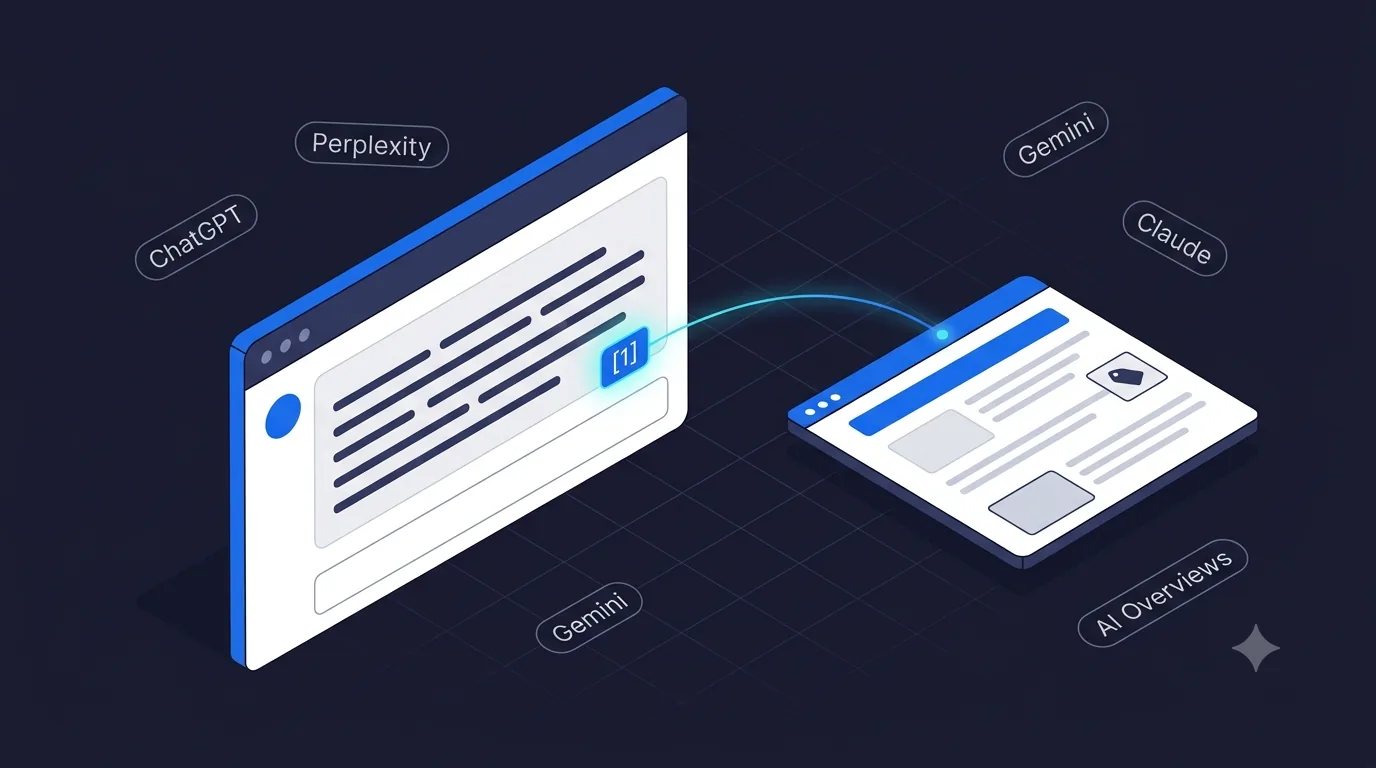
Direct answer: AEO, or Answer Engine Optimization, is the discipline of optimizing your website and content so AI search engines (ChatGPT, Perplexity, Gemini, Claude, Google AI Overviews) cite you as the answer when a buyer asks a question in your category. SEO ranks you in blue links; AEO gets you quoted in the answer. Both matter now, because a fast-growing share of buyer-intent searches no longer end at a Google results page.
If you run a SaaS and you have been treating SEO as a solved problem, this post is the bad news and the playbook. The bad news: most of what you optimized for is being eaten by AI Overviews and AI-first search engines. The playbook: AEO is genuinely learnable, and the early movers in every category are getting cited disproportionately.
What does AEO actually mean?
Answer Engine Optimization is a set of practices that make your content easy for an AI search engine to ingest, understand, trust, and quote back to a user who asked a question. The mechanics overlap with SEO (clean technical foundation, structured data, authoritative content) but the formatting, depth, and content patterns are different.
The two specific shifts that matter:
- The engine summarizes, not links. Where Google would show ten blue links, AI engines synthesize one answer and (sometimes) cite a small number of sources. Being cited is the new ranking. Not being cited is the new "page 2 of Google."
- The user asks in full sentences, not keywords. "best SaaS for X" becomes "what should I use for X if I am a 25-person team selling to mid-market." Content that answers the full-sentence question wins.
AEO is the discipline of writing for this new pattern. Done well, the same content also ranks well in traditional SEO, because the underlying signals (clear structure, authoritative voice, schema markup, trust signals) are aligned. Done badly, you produce keyword-stuffed listicles that neither AI nor humans want to read.
Why does AEO matter for SaaS specifically?
Four reasons SaaS feels this shift harder than most categories.
1. SaaS buyers research with AI now. A founder evaluating tools used to type "best X tool for Y use case" into Google and skim ten links. Today, the same founder asks ChatGPT or Perplexity and gets one or two product recommendations with a paragraph explaining each. If you are not in those one or two recommendations, the founder never visits your site.
2. The buyer journey starts before the click. AI search engines now shape which products buyers consider before they ever land on a marketing page. Brand entity signals, citations across authoritative sources, and llms.txt coverage determine whether your SaaS is in the consideration set at all.
3. The traditional middle-funnel content playbook is decaying. Listicle SEO ("Top 10 X tools in 2026") drove a generation of SaaS organic traffic. Those queries are now answered directly by AI Overviews without sending traffic to anyone. The pages still exist, but they are not the traffic engine they were.
4. Founders who do AEO first will dominate the category narrative. AI engines learn from what is on the web. The early SaaS that publishes well-structured, citation-friendly content with strong trust signals trains the engines to treat them as the authoritative source. That advantage compounds over time and gets harder to dislodge.
How is AEO different from SEO and GEO?
Three search motions exist in parallel right now. Most teams blur them; the ones that win treat them as separate disciplines.
| Motion | What it optimizes for | Where it lives |
|---|---|---|
| SEO | Ranking your page in the Google blue links and AI Overviews source list | Google, Bing |
| AEO (Answer Engine Optimization) | Getting your content quoted as the answer with explicit citation | Perplexity, ChatGPT with search, You.com, Phind |
| GEO (Generative Engine Optimization) | Getting your brand mentioned in answers that do not cite sources | Gemini, free ChatGPT, Claude, Google AI Overviews (sometimes) |
SEO and AEO overlap heavily on technical foundation (schema, site speed, internal linking). AEO and GEO overlap heavily on content patterns (direct answers, structured headings, E-E-A-T signals). All three benefit from clean structured data and authoritative content. A SaaS that does all three well shows up across the entire search surface.
What does an AEO-ready page look like?
Six things change about how you write and structure content when you optimize for AEO.
1. Direct answer up top. The first paragraph (40 to 80 words) answers the headline question directly, in plain language. AI engines pull this paragraph into citations. Burying the answer under intro fluff is the single most common mistake.
2. Question-shaped H2s. Section headings phrased as full questions a buyer would actually type ("How is AEO different from SEO?") beat keyword-soup headings ("AEO vs SEO Comparison"). The question structure makes the page directly answerable by the engine.
3. Self-contained answer blocks. Each section should answer its own question without requiring the reader to scroll up. AI engines pull individual sections out of context; the section has to make sense alone.
4. Structured data (JSON-LD). FAQPage, Article, Service, HowTo, and BreadcrumbList schemas are the minimum. They tell the engine what kind of content this is and which pieces are facts it can cite.
5. E-E-A-T signals. Experience, Expertise, Authority, Trust. Author bios with credentials, dated content, source citations, and original data all signal that the page is trustworthy enough to quote.
6. llms.txt. A plain-text file at the root of your site that summarizes who you are and what your most important pages are. AI bots can read this directly without crawling the whole site. Increasingly relied on by AI engines for brand context.
What changes on the technical SEO side?
The technical foundation that makes a site SEO-friendly is also what makes it AEO-friendly. A few items get extra weight in the AEO context:
- Server-side rendering. AI bots are less patient than Google's renderer. If your content lives only in JavaScript that has to execute, the bot will often skip it. Next.js with SSR, Astro, or any framework that ships HTML works.
- Clean schema validation. Bad JSON-LD breaks the engine's confidence in the rest of the page. Use the Schema.org validator before shipping.
- Markdown alternates. Some AI bots prefer markdown over HTML. Publishing a
.mdversion of each page (discoverable vialink rel="alternate" type="text/markdown") makes ingestion cleaner. - IndexNow. When you publish or update content, push the URL to IndexNow so Bing and Yandex re-crawl within hours. Google does not subscribe yet but the others matter for the AI engines built on their indices.
- Robots and bot allowlists. Decide which AI bots (GPTBot, ClaudeBot, PerplexityBot, Google-Extended) you want to allow. Blocking them blocks citations.
How do you start without rebuilding your whole site?
You do not need to rebuild. AEO compounds page by page. A workable sequence:
Week 1. Audit your top 10 pages by traffic and revenue intent. Identify which ones already rank in SEO and which ones could be cited if rewritten for AEO.
Week 2. Add schema markup (FAQPage, Article, Service) to those 10 pages. Add direct-answer paragraphs to the top of each. Phrase the H2s as questions.
Week 3. Publish an llms.txt at your site root. Add markdown alternates if you have the engineering capacity. Set up IndexNow and add the trigger to your deploy pipeline.
Week 4. Measure. Search for your category-defining questions in Perplexity, ChatGPT, and Gemini. Are you cited? If not, which competitors are? What does their answer look like that yours does not?
From week 5 onward, every new piece of content gets the AEO treatment by default. Your back catalog gets rewritten in priority order. Citations start showing up in 4 to 12 weeks for most categories.
Where does this fit in a real growth motion?
AEO is not a replacement for SEO, paid acquisition, outbound, or product-led growth. It is the layer that protects the top of your funnel as buyer behavior shifts to AI-first search. The right framing:
- SEO still drives most direct buyer-intent traffic in 2026, even with the share decline. Keep doing it.
- AEO wins the buyers who switched to AI search and who would have been your SEO traffic last year.
- GEO wins the buyers who are not even searching anymore, but asking a generative engine for a recommendation.
- Paid, outbound, PLG are unchanged. AEO does not affect them.
A SaaS doing all three search motions well at the same time gets the compounding effect: one piece of well-written content earns SEO rank, AI citations, and brand mentions across the AI engines all at once.
How Workforce Next does AEO for SaaS
We ship a 6-week done-for-you AEO, SEO, and GEO sprint built specifically for SaaS startups. Audit, schema markup, llms.txt, markdown alternates, IndexNow, on-page rewrites, content production, and a 90-day roadmap. You see every change before it goes live. See our AEO, SEO and GEO for SaaS landing page for the engagement model.
If you are deciding whether to invest in AEO at all, our decision guide on AI agents vs hiring a human covers the broader question of when to ship work yourself, hire a partner, or run a blend.
Ready to be the SaaS that gets cited?
If your SaaS is invisible in ChatGPT, Perplexity, or Google AI Overviews and your competitors are not, the gap is going to widen every quarter. Book a discovery call and we will scope a 6-week AEO sprint inside 48 hours.