
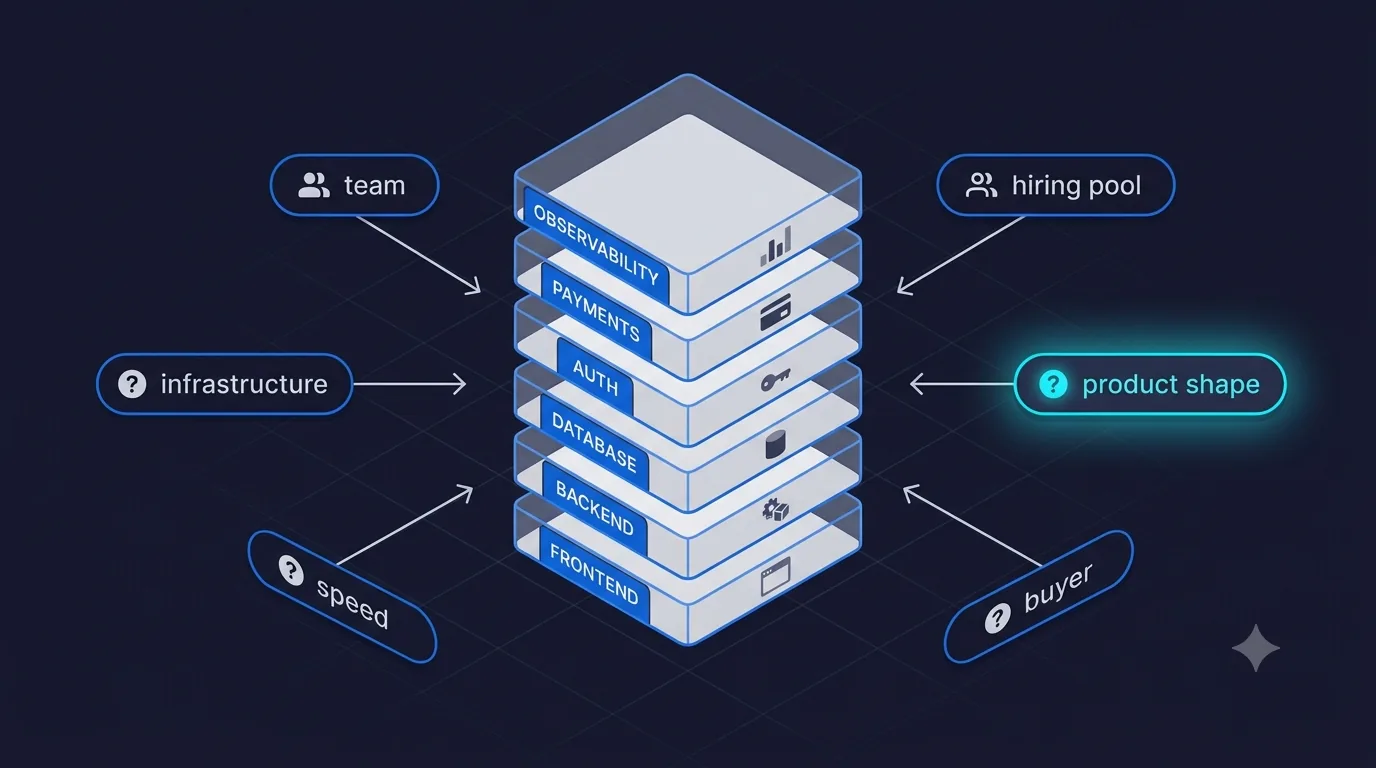
Direct answer: For most SaaS founders in 2026, the right tech stack is the boring one your team can hire for, ship in, and maintain without heroics. Next.js for the frontend, a typed backend in Node.js or Python, Postgres, and a small managed-services layer (auth, payments, email, observability). Pick something more exotic only if you have a specific technical reason that survives a hard conversation with your future self. The questions below decide it for you in 30 minutes.
This is the guide we walk founders through on consulting calls when they ask "what should we build on?" It is not a framework comparison; it is a decision process. If you want a feature-by-feature shootout between five frameworks, this is the wrong post. If you want to ship a SaaS without painting yourself into a corner, read on.
Why most stack debates miss the point
Founders argue about frameworks the way teenagers argue about cars: based on vibes, marketing, and the loudest voices in their feed. The actual constraints on your stack choice are mundane and disappointing:
- What does your current team already know how to ship?
- What can you realistically hire for in the markets you recruit from?
- What shape is your product (consumer web, B2B SaaS, AI-heavy, data-heavy, mobile-first)?
- How fast do you need to move in the next 12 months?
- What are the regulatory or buyer-driven constraints you cannot ignore?
None of those are answered by "Next.js vs SvelteKit." Most stack regrets we see in consulting engagements trace back to a founder optimizing for an aesthetic preference instead of these constraints. The good news: once you answer the constraints honestly, the stack choice is usually obvious.
What are the six questions that actually decide your stack?
Walk these in order. Each one narrows the option space. By the end of the sixth, the stack picks itself.
1. What does your team already ship in? If your two founding engineers are Rails veterans, you are building on Rails. If they live in TypeScript, you are building in TypeScript. "Learning a new stack while building a SaaS" is a romantic story that ends in missed quarters. Stack changes belong in companies that have time and budget for them, which a pre-PMF startup does not.
2. Who do you need to hire in the next 12 months? Look at the job market for the stack you are considering. If you cannot fill a senior role in a quarter, you are constraining your hiring before you have hired anyone. JavaScript and Python have the deepest pools globally. Go and Rust are smaller. Elixir, Clojure, and Crystal are niche enough that you should only pick them if you can credibly recruit from those communities.
3. What does your product actually do? A standard B2B SaaS dashboard has different needs than an AI-heavy product with streaming responses, which has different needs than a real-time collaboration tool, which has different needs than a mobile-first consumer app. Be honest about what your product is and let that shape the backend, not the other way around.
4. What do your buyers expect? Enterprise buyers expect SOC 2, SSO, audit logs, and a SLA. That pushes you toward boring, well-supported choices and away from frameworks that complicate compliance. Consumer-facing products have more freedom. The wrong stack for an enterprise SaaS is one that makes your compliance reviewer's life harder.
5. What is your speed constraint? If you have 90 days to ship a sellable v1, your stack choices are the ones with the smallest setup-to-feature time. Boring stacks with mature tooling beat hot stacks with promising tooling every time when speed matters. If you have 18 months, you have more freedom.
6. What infrastructure are you stuck with? Existing systems, parent-company mandates, regulatory data residency, and customer-specific cloud requirements all constrain the stack. If your largest customer requires AWS GovCloud, your stack needs to deploy there cleanly.
Answering these six honestly takes a 30-minute conversation. Skipping them and arguing about Bun versus Node takes a quarter.
What is the default stack for most SaaS in 2026?
If you do not have a strong reason to deviate, this is the boring-and-correct default:
| Layer | Default pick | Why this one |
|---|---|---|
| Frontend | Next.js (React) on Vercel | Deepest hiring pool, mature tooling, server components, SSR for SEO and AEO |
| Backend language | TypeScript (Node) or Python | TS keeps frontend and backend in one language. Python wins when AI is the core product. |
| Backend framework | Next.js API routes, Fastify, NestJS, FastAPI | Match to language and team familiarity. Avoid bespoke microservices early. |
| Database | Postgres (managed: Supabase, Neon, RDS) | Battle-tested, handles JSON when you need it, every analytics tool integrates |
| Auth | Clerk, Auth0, or Supabase Auth | Do not roll your own. SAML and SSO are required earlier than you expect. |
| Payments | Stripe | Tax handling, subscriptions, dunning, invoicing all covered |
| Resend, Postmark, or AWS SES | Pick one and configure DKIM/SPF/DMARC properly | |
| Background jobs | Trigger.dev, Inngest, or a Postgres-backed queue | Skip Kafka. You do not need it. |
| Observability | Sentry plus a logs provider (Axiom, Datadog, Better Stack) | Cheap insurance against the 2am debugging session |
This stack is unfashionable on Twitter and ships SaaS that closes mid-market deals. The boring choice is the one with the deepest documentation, the largest hiring pool, the most third-party integrations, and the fewest sharp edges in production. Boring at the foundation lets you spend your interesting decisions on the product layer where they matter.
When does boring lose?
The default is wrong in specific, real cases. The honest list:
- AI-core products. If your product is fundamentally an AI agent, RAG system, or model-serving platform, Python on the backend is non-negotiable. The ecosystem (LangChain, LlamaIndex, vector DBs, eval frameworks) lives in Python. Forcing TypeScript here is fighting gravity.
- Real-time collaboration. Operational transforms, CRDTs, WebSocket-heavy products benefit from runtimes built for this (Liveblocks, PartyKit, custom Elixir).
- High-throughput data processing. If your core workload is gigabytes per second of stream processing, Go or Rust on the hot path is sensible. Most SaaS does not have this workload.
- Edge-critical latency. If your product needs sub-50ms response time globally, Cloudflare Workers or similar edge runtimes make sense. Most SaaS does not.
- Mobile-first consumer. A SaaS where the primary surface is a mobile app pushes you toward React Native, Flutter, or fully native development with the API layer adjusted to match.
Notice none of these are "I want to use Rust because Rust is cool." They are product-driven reasons. If you cannot make the case in one sentence of "our buyer needs X and the default stack cannot do X," you do not have a reason to deviate.
What about microservices, monorepos, and the meta-stuff?
Three architectural decisions get founders in trouble disproportionately. Quick reads:
Monolith first, always. Splitting into microservices before you have product-market fit is the most common over-engineering mistake. Build a clean monolith. Split out a service only when there is a specific, measured reason (different scaling profile, different team, regulatory boundary). Most SaaS that hits scale ran as a monolith for years.
Monorepo is fine, not required. If your frontend and backend are in the same language and developed by the same team, a monorepo (Turborepo, Nx) reduces friction. If they are not, keep them separate. Do not adopt a monorepo because it sounds modern.
Do not write your own auth, your own queue, your own email infrastructure, or your own observability stack. Each of these is a startup unto itself. Pay the managed vendor. Use the engineering time you saved on the product.
What does the decision look like in practice?
Three sample SaaS scenarios and the stack we would recommend on a consulting call:
Scenario A: B2B SaaS dashboard, 3-person founding team with TS background, US/EU buyers, 6 months to MVP. Stack: Next.js + Next API routes + Postgres on Neon + Clerk + Stripe + Resend + Sentry + Vercel. Total decisions: maybe an afternoon. Ship.
Scenario B: AI agent product, Python team, technical buyers, 12 months to GA. Stack: Next.js frontend + Python FastAPI backend + Postgres + Clerk + Stripe + Modal or Replicate for model serving + Langfuse for observability + Inngest for jobs. The AI ecosystem dictates Python; everything else is the boring default.
Scenario C: Real-time multiplayer collaboration tool, mixed team, consumer market. Stack: Next.js + Liveblocks or PartyKit for sync + Postgres for persistent state + Supabase Auth + Stripe + a CDN-cached static landing site. The product shape (real-time collab) is the deviation reason; the rest stays boring.
In all three, the founder spent their decision energy on the product, not the framework. That is the goal of stack selection: make the choice fast, make it sensible, then never think about it again until your scale or your team changes.
What we tell founders on consulting calls
The single most useful thing you can do before picking a stack is to write down your answers to the six questions above. Not in a slide. In a paragraph. If you cannot defend the stack pick in two sentences after that exercise, you do not have a stack problem; you have a clarity problem about what you are building and for whom.
If you want a sanity check before you commit, that is what our IT consulting engagement is for. We have walked enough founders through this to know which deviations from the boring default are usually right and which usually become a regret 18 months later. For the engagement model and how scoping works, see our MVP consulting page.
If your stack question is downstream of an even earlier question ("should we build this with AI agents, with a human team, or both?"), our decision guide on AI agents vs hiring a human covers that.
Ready to validate the stack pick before you commit?
If you are about to commit a year of engineering to a stack, an hour with a consultant who has shipped on most of them is cheap insurance. Book a discovery call and we will walk the six questions with you and give you the honest read.