
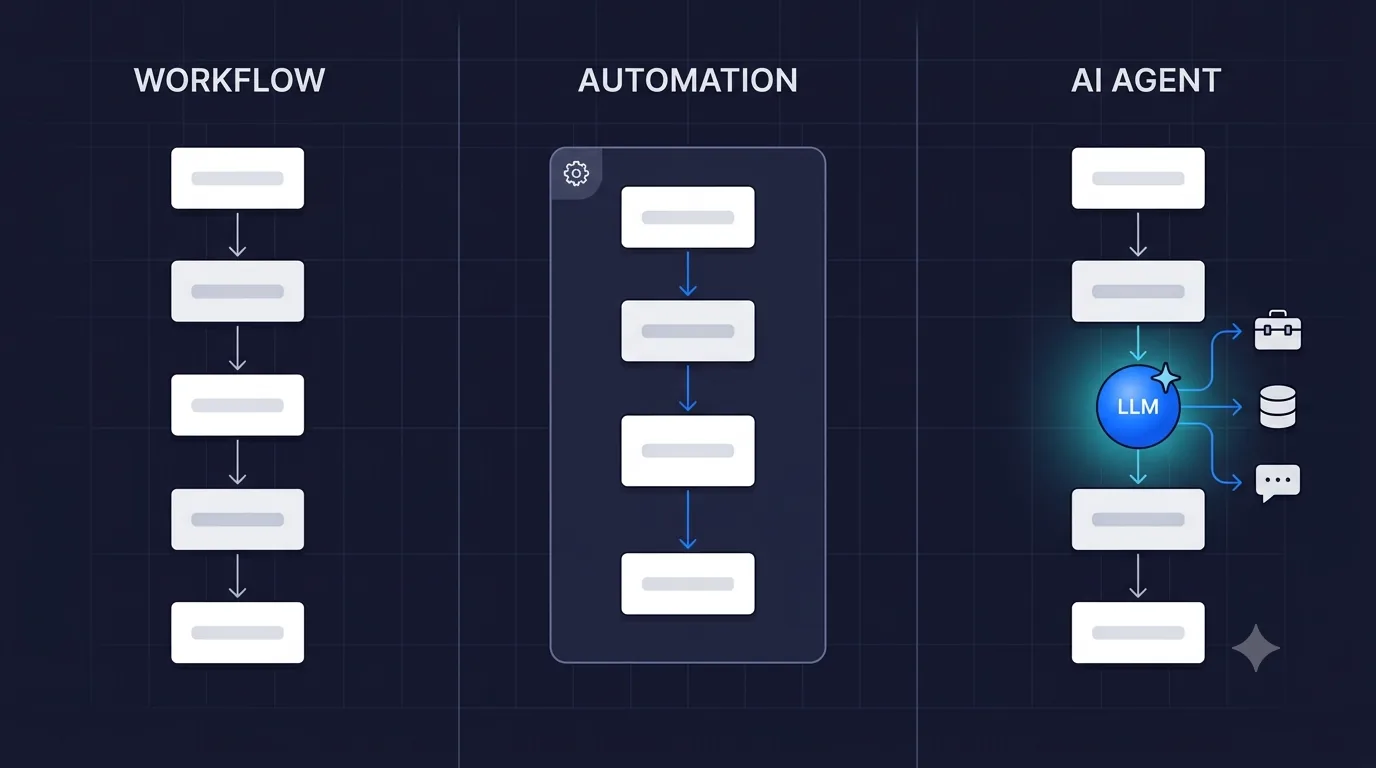
Direct answer: Workflows are deterministic step sequences. Automation is workflows that run without human input. AI agents are workflows where at least one step uses an LLM to make a judgment call that rules alone cannot make. The three terms get used interchangeably in marketing copy, but they describe different things and they cost different amounts to build and run. Most teams need automation, think they need agents, and end up overpaying for both.
If you are a founder or operator scoping a project and the vendor keeps switching between "agent," "automation," and "workflow," this post is the definitions, the decision criteria, and the honest read on which one fits your work.
What is a workflow?
A workflow is a defined sequence of steps that move a piece of work from start to finish. It can be drawn on a whiteboard. It can be written down as "first this, then that, then this other thing." It does not need to be automated. A new-hire onboarding checklist is a workflow. A monthly invoice review process is a workflow. A customer support ticket escalation path is a workflow.
Workflows are about structure. The defining property is that the steps and their order are explicit. A team executing a workflow knows exactly what to do at each stage, in what order, with what tools. If a human is doing every step manually, it is still a workflow. It is just a manual one.
Most companies have hundreds of workflows. Most are undocumented and live in people's heads. A surprising number of "we need AI" projects are actually "we need to write down our workflow before we can decide what to do with it" projects.
What is automation?
Automation is a workflow that runs without human input. The steps are the same; the difference is that software executes them on a trigger instead of a human kicking each step off.
Automation is deterministic. The same input produces the same output every time. The rules are explicit: "if the form submission has X field, send it to Y queue; if it has Z field, send it to W queue." There is no judgment, no creativity, no learning. The system does what you told it to do, repeatedly and reliably.
The classic automation tools (Zapier, Make, Workato, n8n in its non-AI mode) are built for this. They give you a visual builder for chaining triggers, conditions, and actions. The work is in mapping your workflow correctly and handling edge cases; the tool runs it.
Automation wins when the work is high-volume, the rules are stable, and the cost of being wrong is contained. Most operational work in a SaaS company fits this profile: lead routing, ticket triage, billing reconciliation, recurring report generation, internal notifications. A surprising amount of "we need an AI agent" intent collapses into "we need a workflow with three branches and a Slack notification."
What is an AI agent?
An AI agent is a workflow where at least one step uses an LLM to make a judgment call that simple rules cannot make. The LLM reads context, decides, and produces an output that drives the next step. The rest of the workflow can still be deterministic; what makes it an agent is the presence of judgment in the loop.
Three properties separate agents from automation:
- Judgment. The LLM step makes a decision based on context that varies from case to case (read this customer email and classify its intent; read this invoice and decide if it is for a recurring vendor or a one-off).
- Non-determinism. The same input can produce slightly different outputs across runs. Good agent design uses prompt engineering, eval harnesses, and guardrails to keep this variance acceptable.
- Tool use, often. Most production agents call tools (read a database, send an email, look up a record, post to Slack) based on what the LLM decides to do at each step. This is what people mean when they say "agentic" rather than just "AI-powered."
An AI SDR is an agent. A support triage system that reads a ticket, classifies it, drafts a response, and routes to the right human is an agent. A data agent that reads a question in plain English, writes the SQL, queries the warehouse, and explains the result is an agent. None of these can be built with deterministic rules because the input space is too messy.
The decision matrix
The clearest test is to look at the steps in your workflow and ask, for each one, "could a clear written rule handle this?"
| What you are looking at | What you actually need |
|---|---|
| You have a documented sequence but a human runs it | Workflow. Document it first, then decide if automation is worth it. |
| Every step can be expressed as a clear rule, high volume | Automation. No AI needed. |
| One or two steps need judgment the rules cannot capture | AI-augmented automation. Most of the workflow is rules; the LLM handles the judgment step. |
| The agent has to decide what to do next at each step based on context | AI agent (agentic). Higher cost, more complex, but the only path for genuinely open-ended work. |
| The work is low-volume and high-judgment | A human. Do not over-engineer. |
Most real systems are blends. A finance ops automation might run 90% as deterministic rules with one LLM step for invoice line-item categorization. A sales ops setup might have rule-based lead routing with an LLM step for ICP fit scoring. Calling the whole thing "an AI agent" is marketing; the honest description is "an automation with one AI step."
What changes in cost and complexity
The three categories have different cost shapes. The differences matter for scoping decisions.
Workflows cost time, not money. Drawing one up is a meeting. The cost is the discipline to write it down and keep it current.
Automation has setup cost and low run cost. Building a clean Zapier or n8n automation is days to a few weeks depending on integrations. Once it runs, the per-execution cost is small and predictable. The main ongoing cost is when an API changes upstream and the workflow breaks.
AI agents have higher setup cost, variable run cost, and ongoing eval overhead. Setup is days to weeks, similar to automation, plus prompt engineering and eval harnesses. Run cost depends on model usage and scales with volume in ways that pure automation does not. Ongoing maintenance includes monitoring for output drift, regression testing when models update, and handling the long tail of edge cases the LLM gets wrong.
This is why "let us use an AI agent" should not be the default answer. If your work is deterministic, an agent is more expensive and less reliable than the automation alternative. If your work genuinely needs judgment, an agent is the only thing that will work and the cost is justified.
Where each one wins (concrete examples)
From the work we ship every week:
Pure workflow (document, do not automate yet): a 5-person team's monthly board pack. Low frequency. High judgment per cell. The right move is a clean checklist and a calendar reminder, not an automation.
Pure automation (no AI needed): new Stripe customer triggers Welcome email plus a new row in the analytics warehouse plus a Slack ping to sales. Three deterministic steps. Adding an LLM here would slow it down and introduce variance for no value.
AI-augmented automation: inbound contact form submissions get parsed for intent (LLM step), enriched, scored, and routed to the right person. Most of the workflow is deterministic; one step uses judgment.
AI agent: an AI SDR that researches accounts, decides which value prop to lead with, writes outbound, triages replies, and books meetings. Each step requires context-aware decisions the rules cannot make in advance.
Human (do not automate): handling a strategic enterprise customer's escalation. Low volume, high stakes, judgment-dense. An agent here would create more problems than it solves.
How to scope the right one for your work
A 4-step exercise we walk customers through on discovery calls:
- Draw the workflow on paper. If you cannot, you do not have a workflow problem yet; you have a documentation problem. Fix that first.
- Mark each step as "rule-based" or "judgment-required." Be honest. Most steps are rule-based. If everything is judgment, you are looking at a human-only workflow.
- Count the rule-based steps and the judgment steps. If 80%+ of steps are rule-based, you are building automation (possibly with one or two AI steps). If most steps need judgment, you are building an agent.
- Estimate volume and stakes per case. High volume plus contained stakes plus mostly rule-based = automation, ship now. Low volume plus high stakes plus judgment-heavy = keep it human, do not build anything.
This single exercise saves more money than any vendor pitch. Most "we need an AI agent" briefs come back as "we need to document our workflow and then build a four-step automation with one AI step." The cost difference is significant and the reliability difference is bigger.
How Workforce Next does this
We start every automation engagement with this exercise. We do not sell agents when automation will do, and we do not sell automation when documentation will do. The scoping call is free and the proposal includes the honest call on which of the three categories your work fits.
For the engagement model, see our automation consultants page. If you are weighing this against hiring a human instead, our decision guide on AI agents vs hiring a human covers that question directly. And if your category-defining buyer is now researching in AI search instead of Google, our AEO post covers why that matters.
Ready to scope the right one?
If you are looking at a workflow and unsure whether you need documentation, automation, an AI agent, or just a human, book a discovery call. Scoped proposal in 48 hours with the honest read on which category fits.