
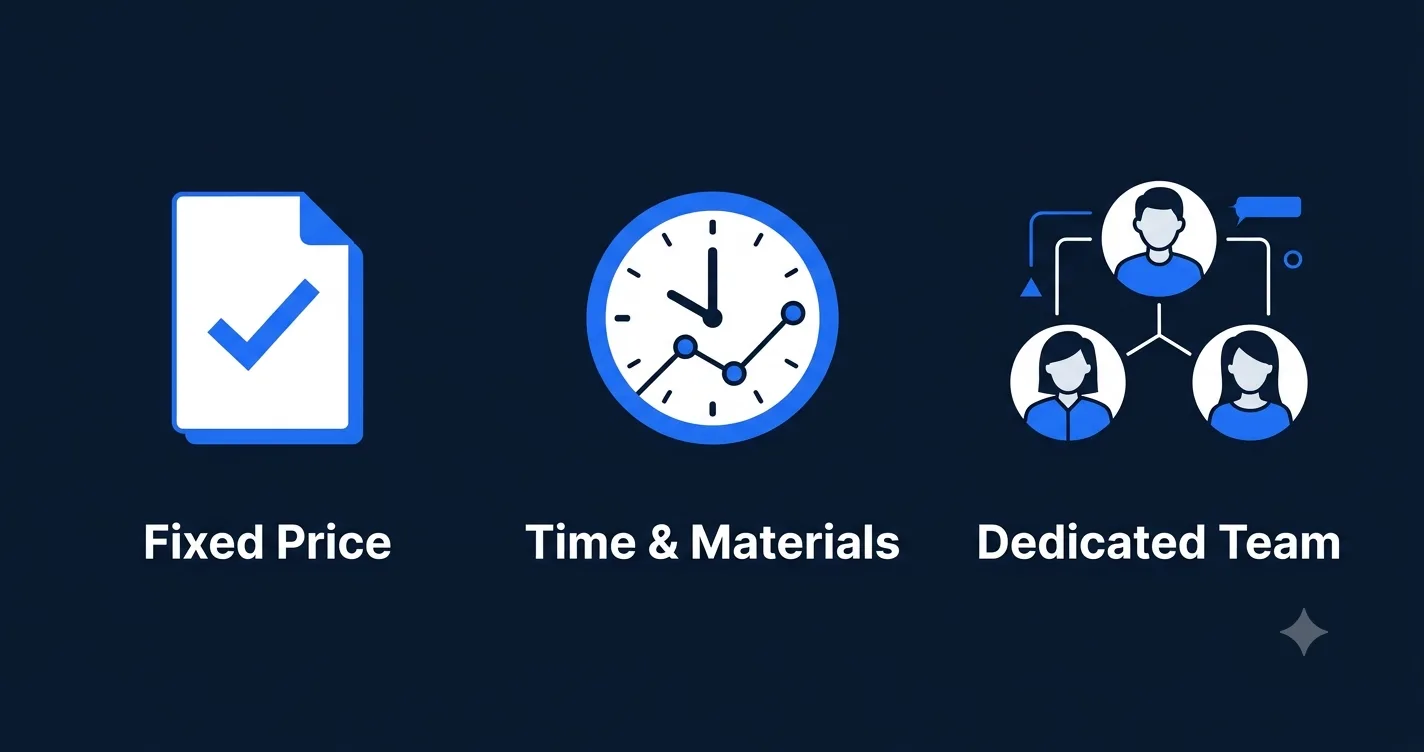
Most conversations about development engagement models start with rates. That is the wrong place to start. The model you choose does not determine who builds your software. It determines who absorbs the risk when the scope changes, who has the incentive to flag problems early, and how much management overhead lands on you. Get the model wrong and you end up paying for two things: the work and the friction.
Fixed price: what it is and when it actually works
A fixed-price contract defines the scope, the deliverables, and the total cost upfront. The vendor absorbs the risk of overruns. You know the number before work starts.
That sounds appealing until you realize what fixed price requires: a scope that will not change. In practice, software scopes change. Users want something slightly different once they see the first version. The API the feature depends on behaves differently in production. A competitive move makes one feature more urgent and another irrelevant. Every change in a fixed-price contract is a change order, a negotiation, and usually an opportunity for the vendor to recoup margin they priced in defense against uncertainty.
Fixed price works well for:
- Small, bounded projects where the scope is genuinely final: a landing page, a data migration, a one-off integration with a known spec
- Projects where you have done this before and can specify every edge case in advance
- Work with a clearly defined acceptance criterion that both parties agree on before a single line is written
Fixed price tends to break down for:
- Anything involving new product discovery, because discovery changes scope
- Longer engagements, because six months of uncertainty cannot be fully priced at month one
- Work where the quality of judgment matters more than the output of a spec, because a spec cannot capture judgment
The deeper problem with fixed price on complex work is incentive misalignment. The vendor priced assuming a certain scope. When the scope expands, they are not indifferent: they want a change order, or they want to ship something narrower than what you actually need and call it done. Neither outcome is good for you.
Time and materials: what it is and when it actually works
A time-and-materials contract charges for hours worked plus materials consumed. Scope is not fixed. The client absorbs the cost risk of changes; the vendor has no incentive to limit scope.
T&M gets a reputation for runaway costs, and that reputation is earned when the engagement has weak structure. But T&M is the honest model when scope is genuinely uncertain, because it does not pretend certainty exists. A vendor quoting a fixed price on a genuinely uncertain project is not eliminating risk. They are hiding it and pricing a premium against it.
T&M works well for:
- Projects where you need flexibility as requirements evolve through user feedback or market changes
- Exploratory builds, prototypes, and MVPs where you are discovering what to build as you build it
- Ongoing enhancements to an existing system where the backlog is living and priorities shift
T&M tends to break down for:
- Clients without strong enough product management to control scope on their side
- Vendors without transparent reporting, because opaque billing is hard to audit
- Large teams over long timelines without clear sprint goals, because the work can expand to fill the available hours
T&M does not mean no accountability. The best T&M engagements define weekly or sprint-level outputs, track velocity, and align on what good looks like for each deliverable. The model is not the problem. The absence of structure within the model is.
Dedicated team: what it is and when it actually works
A dedicated team is a group of engineers who work exclusively on your product, operating as an extension of your internal team. The billing is typically a flat monthly cost per person, roughly like a full-time headcount you do not source, manage administratively, or replace on your own.
The key difference from T&M is continuity. A T&M engagement bills for hours and can start fresh each sprint. A dedicated team accumulates context: about your codebase, your product decisions, your team dynamics, your technical debt, and your customers. That context is worth something. It is also what you lose when an engagement ends and you start over with a new vendor.
Dedicated team works well for:
- Product companies that ship continuously and need engineers who understand the full system, not just the current ticket
- Teams scaling fast enough that they cannot hire and onboard quickly enough to meet roadmap demand
- Companies that want the cost structure of offshore talent without the administrative burden of setting up an entity in India
- Engineering teams that want a partner who flags architectural issues and pushes back on bad decisions, not just one that executes tickets
Dedicated team tends to break down for:
- One-off, bounded projects with no ongoing roadmap, because you are paying for continuity you will not use
- Teams that are not ready to integrate external engineers into their process, because a dedicated team requires real collaboration, not just task delivery
- Engagements where the vendor does not screen for working style and culture fit, because technical skill without fit produces an expensive contractor dynamic, not a team dynamic
The decision in practice: three questions
Rather than defaulting to a model, answer these three questions about your specific engagement:
How final is the scope? If you can write a complete spec today and expect it to hold, fixed price is viable. If the spec will change as you learn more, T&M or dedicated is more honest.
Is this a project or a program? A project has a start, an end, and a handoff. A program is ongoing work with a living backlog. Projects fit fixed price or T&M. Programs fit dedicated teams.
How much does accumulated context matter? If the work is largely independent of prior decisions (a data migration, a standalone integration), context matters less and project-based models work fine. If the work is deeply coupled to your existing system and product direction, context compounds over time and the cost of starting fresh every engagement adds up quickly.
How Workforce Next structures each model
For fixed-price work, we scope it carefully upfront with a written spec both sides sign off on, and we define acceptance criteria in the same document. Change orders are priced transparently before work begins. We do not quote fixed price on work where we cannot confidently define those criteria.
For T&M engagements, every sprint has defined goals, and we report velocity weekly. You see exactly what was built, what was not, and why. No surprise invoices.
For dedicated teams, we match engineers on 12 parameters that go beyond technical skills, including working-rhythm fit and long-term career alignment with your product, because a dedicated team member who leaves in four months is not actually dedicated. See how we structure dedicated pods for startups, or if you are at the scale where running your own India entity makes sense, see our Build-Operate-Transfer GCC model.
If you are not sure which model fits your current engagement, start a conversation. We will tell you honestly which one makes sense, including when fixed price or T&M is the right call and a dedicated team is not.