
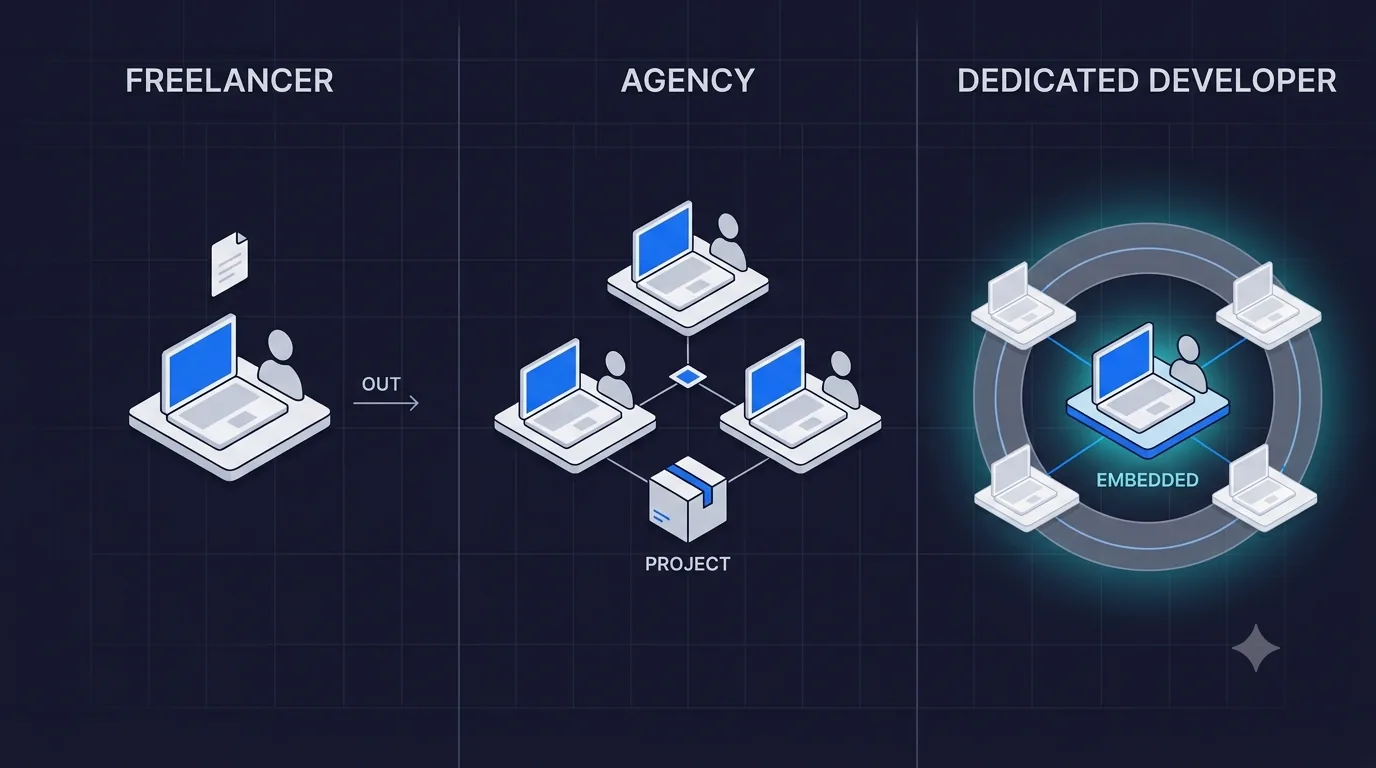
Direct answer: Hire a freelancer when the work is short, well-scoped, and you can manage the integration yourself. Hire an agency when you want a team to own delivery of a fixed-scope project end to end. Hire a dedicated developer when you need an engineer embedded with your team for months, building up context and shipping continuously alongside your in-house people. Picking wrong is expensive; picking right is mostly about being honest about which problem you actually have.
This is the framework we walk founders through on talent consulting calls. It is not a sales pitch for any one model (we offer all three). It is the honest read on which one fits which job, including the cases where the answer is "none of the above, hire someone full-time."
What is the actual difference between the three?
The three models are sold as if they are interchangeable. They are not. The differences that matter are not about price or location. They are about ownership, continuity, and context.
| Model | Who owns delivery | Continuity | Context buildup |
|---|---|---|---|
| Freelancer | You own scoping, integration, and review | Short engagement, ends at deliverable | Low. Freelancer leaves; context leaves with them. |
| Agency | Agency owns delivery, you own acceptance | Project length, ends at handover | Lives in the agency's docs and people, not yours |
| Dedicated developer | Shared with your team like an in-house engineer | Months to years, persistent | High. Compounds with your codebase and team. |
Notice how nothing in this table is about cost. The expensive option is whichever one you pick wrongly for the job. A freelancer for a 9-month embedded engineering need is more expensive than a dedicated developer because you pay the context-rebuild tax every time they hand off. An agency for a 4-day scripting task is more expensive than a freelancer because of the coordination overhead. Cost follows fit; it does not drive it.
When does a freelancer win?
A freelancer is the right pick when all four of these are true:
- The scope is small and clear. You can write the spec in a paragraph and the deliverable is testable.
- You own the integration. You have an engineer or technical founder who can review the work, merge it, and own production.
- The work ends. There is no expectation of ongoing maintenance or future feature work in the same area.
- You can tolerate variance. Freelancers vary widely. You will run a few in parallel before you find one you trust.
The clean fits: a one-off script, a specific bug you cannot reproduce, an isolated feature like a CSV export, a design-to-HTML conversion, a single integration with a third-party API. Anything that lives at the edge of your codebase and does not require deep context.
Where freelancers go wrong: founders use them as a cheap substitute for embedded engineering. The freelancer ships the feature, hands it off, and three months later your team has no idea how it works. Context evaporates and the next freelancer rebuilds it from scratch. The "cheap" path turns into the most expensive one.
When does an agency win?
An agency is the right pick when:
- The project has a defined end state. A mobile app launch, a website rebuild, a data migration. Something you can describe with a "done" criterion.
- You do not have in-house ownership for the project type. Your team is a SaaS backend team; the project is a marketing microsite. Different muscle.
- You want one throat to choke. Project management, design, engineering, QA all from the same vendor with a single point of accountability.
- Speed matters more than handover quality. Agencies ship faster on isolated projects than building the same capability in-house.
The clean fits: a marketing site rebuild, a one-time mobile app version, a data warehouse migration, a brand-new product surface that lives separately from your core stack, a compliance project with a deadline.
Where agencies go wrong: founders use them for ongoing product engineering. The agency ships v1, hands over a codebase your team does not understand, and now you are coupled to the agency for every change because nobody internal owns the code. Six months later you are paying agency rates to maintain something that should have been built by an embedded engineer who is still there to maintain it.
When does a dedicated developer win?
A dedicated developer is the right pick when:
- You need ongoing engineering capacity. Not a one-off project, not a fixed scope. Continuous feature work over months.
- Context matters. The work touches your core codebase, your domain logic, or your customer-facing product, and the engineer's value compounds the longer they are there.
- You want them embedded. Daily standups, code review with your team, in your Slack, in your repo, looks like an in-house hire.
- You are not ready for a full-time hire. Cash, hiring lead time, or uncertainty about the role spec makes a permanent hire the wrong move right now.
The clean fits: building out a SaaS product post-PMF, extending a platform with new modules, taking over a feature area you do not have internal capacity for, augmenting an in-house team that is shipping faster than it can hire. Anything where the engineer's value six months in is materially higher than their value on week two.
Where dedicated developers go wrong: founders treat them like agency engagements, with arms-length communication and waterfall expectations. The whole point of a dedicated developer is the embedded relationship; if you do not let them in, you are paying for an agency-style engagement at the wrong price shape.
The decision question that decides it
Skip the model comparison and answer one question: is the work better done by a person who knows your codebase or a person you brief on a spec?
If the answer is "knows your codebase," you want a dedicated developer. The context-compounding is the whole product.
If the answer is "brief on a spec," go to the next question: is the scope a deliverable you can describe in a sentence, or is it a project with multiple deliverables, design needs, and a delivery timeline?
If it is a single deliverable, you want a freelancer. If it is a multi-deliverable project, you want an agency.
That is the whole framework. Three models, one decision tree, no marketing soup. The rest is execution.
What founders get wrong about cost
Cost comparisons across the three models are nearly always misleading because they compare hourly or daily rates without counting the surrounding work.
- Freelancers look cheap. They are, if you scope perfectly and integrate yourself. They are not if you spend founder time scoping and reviewing, or if you re-hire a different freelancer for the next slice.
- Agencies look expensive. They are, if the work could have been done by a single freelancer. They are not if the alternative is your three-person team taking a quarter to learn a domain they will never use again.
- Dedicated developers look in-between. They are, if you actually embed them. They are the most expensive option if you treat them like a freelancer (no context buildup, no embedding, used for isolated tasks).
The honest cost framing: the cheapest model is the one that fits the job. The expensive model is the one you forced into a job it was not built for.
What about hiring a full-time engineer instead?
Full-time hiring is the right call when:
- You have a role you are confident you will need for 2+ years
- You have the cash to fund the FTE through your next milestone
- You can wait 8-16 weeks to source, interview, hire, and onboard
- You have an engineering culture and process the new hire will plug into
If any of these are missing, you are better off with a dedicated developer in the interim. The interim role is not a substitute for the FTE; it is a way to get engineering output while the FTE search runs in parallel. Many founders convert a strong dedicated developer into a full-time hire after 6-12 months when the role and the person are both proven.
How Workforce Next does this
We deploy all three models. We do not push founders toward whichever is most lucrative for us; we push them toward whichever fits the work. The scoping call is free and the proposal includes our honest read on which model is right.
If you know you need ongoing engineering capacity in a specific stack, see our full-stack developers page or our AI developers page for the dedicated developer engagement. If your work is a fixed-scope project that needs end-to-end delivery, that is an agency engagement and the discovery call is the way in.
If you are weighing humans against AI agents for the same work, our decision guide on AI agents vs hiring a human covers that question. If you are still figuring out the stack you would even hire for, our tech stack decision guide walks the six questions that decide it.
Ready to scope the right model?
If you are not sure whether you need a freelancer, an agency, a dedicated developer, or a full-time hire, that is the most common question we get on talent calls. Book a discovery call and we will give you the honest read in 30 minutes.