
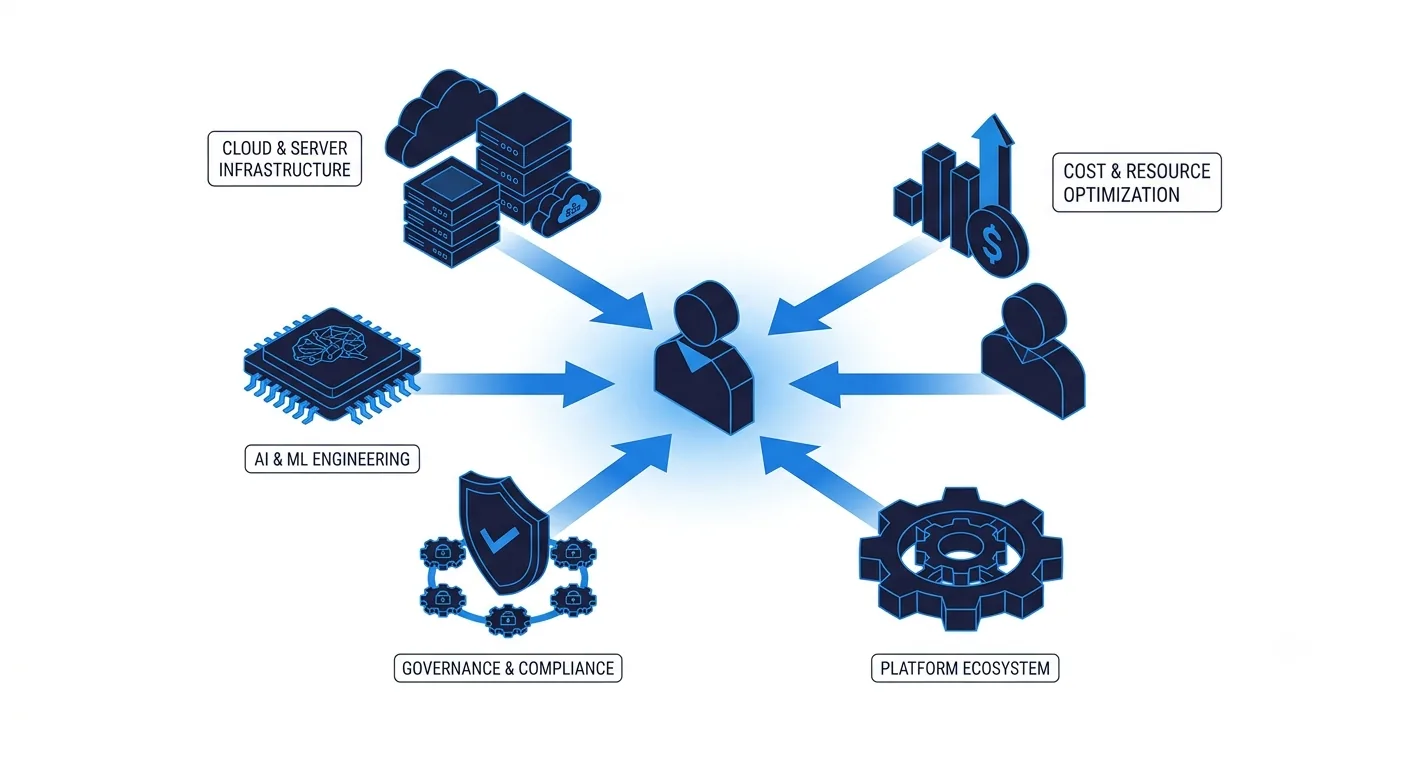
DevOps hiring is harder right now than it was two years ago, and it is not a perception problem, it is a scope problem. The job absorbed new responsibilities faster than the supply of engineers who can actually do all of them grew. If you are struggling to fill the role, the fix is not a bigger budget or a longer job post, it is understanding exactly which parts of the scope matter for your team and vetting specifically for those.
Why has DevOps hiring gotten harder in 2026?
Five things expanded the role at the same time, and most job posts still describe the 2021 version of it.
- Multi-cloud and multi-cluster complexity compounded. Most teams past a certain size are no longer running one account on one cloud. Multiple AWS accounts, a second cloud for a specific workload, multiple Kubernetes clusters per environment, that is the normal shape now, and it needs someone who has actually operated it, not someone who completed a single-cluster tutorial.
- AI and ML workloads added net-new infrastructure surface area. GPU provisioning, vector database operations, inference serving, and controlling the cost of LLM API usage did not exist as DevOps responsibilities three years ago. They do now, and very few engineers have real production experience with all of it.
- Compliance pressure moved down-market. SOC 2 and similar audits used to be an enterprise-only concern. Now mid-market SaaS companies need it to close deals, and compliance is mostly a platform problem: audit trails, access control, change management, backup discipline. That is DevOps scope, not a separate hire.
- The role shifted from firefighting to platform-as-a-product. Companies that used to tolerate a part-time ops hire now expect an internal developer platform that product engineers can self-serve against. That is a meaningfully higher bar than keeping servers up.
- Cost ownership got added on top of reliability. The same engineer who used to just keep things running is now also expected to own cloud cost efficiency, because cloud spend scrutiny did not go away when interest rates did whatever they did. One person, two full-time concerns.
Add those up and the honest version of the role today is platform engineering, SRE, FinOps, and security, worn by one person at most companies. The pool of people who can do all four well is much smaller than the pool of people with "DevOps" on their resume.
Why does supply feel so thin if the job title has not changed?
Because the title did not change, but what good looks like did, and a lot of candidates optimized for the old version. Certifications and tool keywords are easy to collect and easy to put on a resume. Real incident response judgment, Terraform module design instinct, and the ability to explain a platform tradeoff to a non-technical executive are not things you can bullet-point your way into. There is also a quieter supply problem: a meaningful share of experienced DevOps engineers got burned out on 24/7 on-call during the last few years and are now actively selecting for roles that do not require it, which shrinks the pool further for companies that have not solved the on-call problem themselves.
What should you actually screen for, instead of certifications and tool names?
Four things predict whether someone can do this job well under real pressure, and none of them show up on a certification.
- Real production incident history, not textbook answers. Ask about the last incident they led, not an incident they studied. Strong answers include scope, blast radius, what they tried that did not work, and the change they shipped afterward. Weak answers describe what "the team" did.
- Infrastructure-as-code judgment, not just syntax. Show them an existing Terraform layout and ask what they would refactor. Someone with real instinct spots a brittle module interface before you point it out.
- Security and IAM instinct. The single clearest signal is whether they default to reducing permissions when they do not strictly need them, versus leaving a service account wide open because it was easier.
- Communication under pressure. Platform work fails in practice when an engineer cannot explain a tradeoff to product or an executive in terms that land. This is as important as the technical depth and gets screened for far less often than it should.
Does a curated hiring model actually solve this faster than posting the role yourself?
It depends on whether you have the in-house ability to run the screening above at the depth it needs, and the time to do it while the gap is actively costing you. Posting the role yourself and running your own technical interviews is a real option if you have someone on the team who has hired senior platform engineers before and can tell a real incident story from a rehearsed one. If you do not, or if the search has already dragged for months, a vetting partner that screens specifically for these signals, not resume keywords, closes the gap faster. See our DIY vs marketplace vs hand-picked hiring comparison for the fuller decision framework, the short version for DevOps specifically is that the screening depth required here is higher than most internal processes are built for.
What is the actual fastest path to a vetted DevOps engineer right now?
Start by being honest about which of the five expanded responsibilities actually matter for your team. Not every company needs GPU infrastructure experience; most do need real Kubernetes and Terraform depth and someone who will not panic during an incident. Scope the hire narrowly against what you actually have in production, then screen specifically for the incident history, IaC judgment, security instinct, and communication signals above rather than a longer tool list. That is also exactly how we screen every DevOps and SRE engineer we place, detailed on our DevOps hiring page, including the Follow-the-Sun model for teams whose real problem is on-call burnout rather than a missing skill.
If you want this scoped against your actual stack and on-call pain rather than a generic checklist, talk to us and we will tell you honestly what you need.