
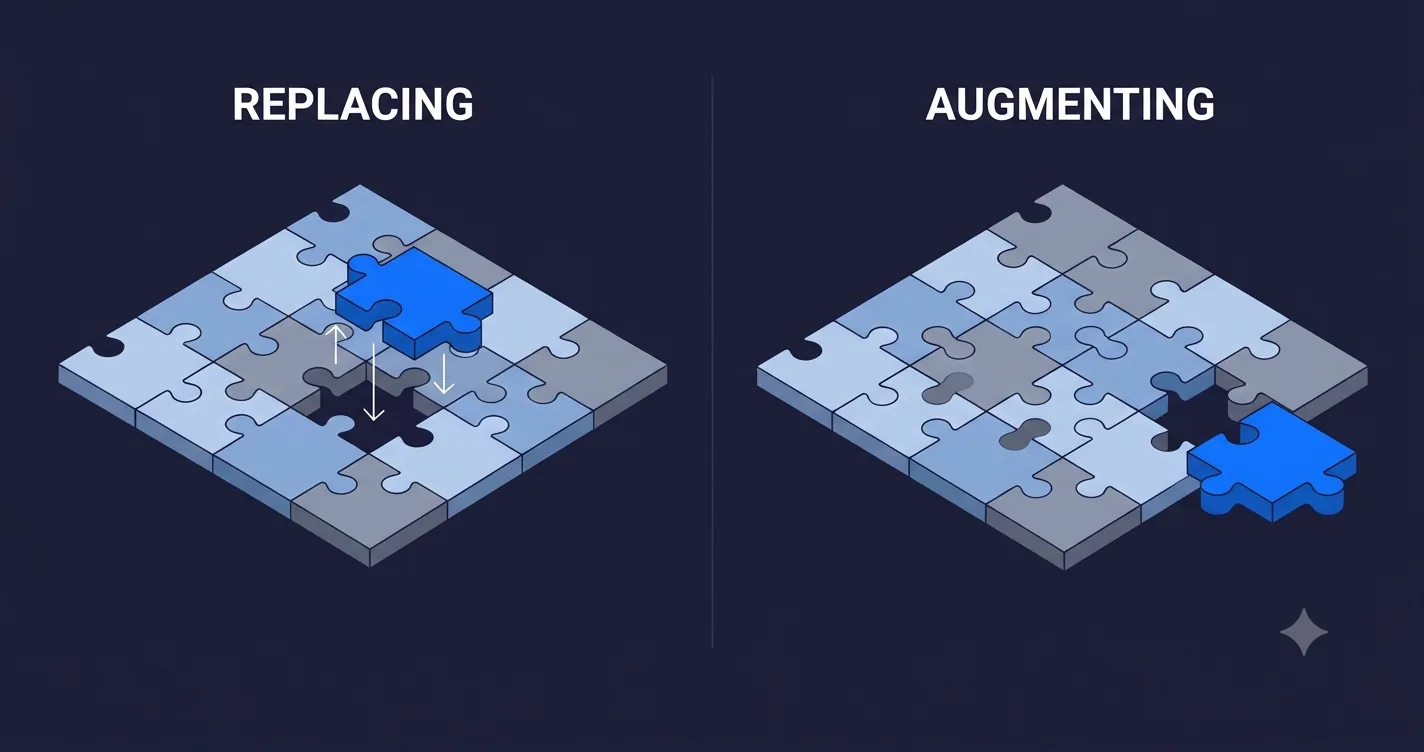
A dedicated remote developer from India or Eastern Europe isn't a replacement for your in-house team, and treating them like one is the fastest way to waste the engagement. The question isn't "can this person do what my team does," it's "what is my team not getting to, and does this person actually close that gap." Here's how augmenting actually works next to a team that already exists.
What's the real difference between augmenting and replacing?
Replacing fills a seat that already has a job description and a backlog of expectations attached to it. Augmenting adds capacity against work that's currently not getting done, whether that's a backlog nobody has time for, a skill gap nobody on the team has, or raw throughput your roadmap needs but your headcount doesn't support yet. A replacement hire gets measured against the person who left. Fair or not, that is the comparison everyone makes. An augmentation hire gets measured against the work that wasn't happening before they joined. Confusing the two causes real damage. The new engineer either underperforms against an unfair bar, or sits underused because nobody actually scoped what they are there to do.
How do you decide whether you need augmentation or a replacement?
Ask what actually breaks if this role goes unfilled for 3 more months. If a specific person's departure left a hole in team knowledge, ownership of a system, or a required skill set, that's replacement. If the team is intact and functioning but drowning in more work than 5 or 6 engineers can realistically clear in a normal 2-week sprint, that's augmentation. Most companies default to replacement thinking even when augmentation is what they need. It is the familiar shape of a hiring decision.
Where does a dedicated remote developer actually plug in next to an existing team?
Three places, most commonly. Backlog capacity: a second or third engineer on a feature team that has been running 1 person deep for 2 or 3 sprints too long. Specialist gaps: a stack or skill your in-house team does not have and does not need permanently, like a one-off AWS to GCP migration or a narrow OpenAI or Anthropic integration. And timezone coverage: work that keeps moving after your core team logs off, picked up at the end of a US workday and handed back clean by 9am the next morning. Each of these three scenarios is a different scoping conversation, and a vendor who doesn't ask which one you need before staffing the role is guessing.
Does the augmented developer report to the same manager as the in-house team?
Usually yes, whether the developer sits in Bangalore, Krakow, or Austin, and this is one of the details that separates a real augmentation model from a disguised outsourcing handoff. If the new engineer reports into a separate account manager who relays status back to you over email instead of Slack, you've hired a vendor, not augmented your team. A dedicated developer should sit in the same standups, take direction from the same engineering lead, and show up in the same sprint board as everyone else. The only real difference is where they are employed.
What happens to team dynamics when you add someone who isn't a full-time local hire?
Less than people expect, if the engineer is actually integrated rather than bolted on. The friction usually comes from treating the remote developer as a separate unit on a different Zoom call, a "them" doing tickets that get assigned over the wall instead of discussed in planning. Teams that fold the new engineer into actual technical conversations, code review on GitHub or GitLab, architecture debates, sprint retros, see faster trust-building than teams that keep them purely execution-focused. The title "augmented" shouldn't mean "kept at arm's length."
How do you know augmentation is working instead of just adding headcount?
Track what specifically got unstuck, in concrete terms, not a general sense of things feeling smoother. Did the backlog item that sat untouched in Jira or Linear for 2 sprints finally ship? Did the specialist gap that was blocking a launch get closed? If you cannot point to a specific Jira ticket, a specific launch date, or a specific metric that moved because of the added capacity, the engagement is just adding cost without solving the actual problem you brought the person in for. Good augmentation has a named target from day one, not a vague "help out where needed" brief.
If you're trying to figure out whether your situation calls for augmentation or a direct hire, our full-stack and backend engineer pages cover the dedicated-hire model, and dedicated developer vs freelancer vs agency walks through the cost side of that decision. For what the first two weeks actually look like once you decide, read what adding a remote engineer looks like in the first two weeks. For how we structure team integration from week 1 onward, see how we work.